Aviation Alphabet Basics: Learn It In 10 Minutes

Published August 27, 2026
Have you ever listened to pilots communicate and wondered why they say “Alfa,” “Bravo,” and “Charlie” instead of simply using the letters A, B, and C?
The aviation alphabet is designed to make spoken communication clearer, especially when radio transmissions are affected by noise, distance, static, accents, or interference. A simple letter can easily be misunderstood, but a distinct code word helps ensure the message is received correctly.
Whether you’re a student pilot, aviation enthusiast, aircraft owner, or simply interested in how pilots communicate, learning the aviation phonetic alphabet is easier than you might think. In just a few minutes, you can understand the basic system used throughout the aviation industry.
This guide covers the complete aviation alphabet code, explains why it matters, and shows how pilots and air traffic controllers use it in real-world communication.
Why Is Clear Communication So Important in Aviation?
Aviation depends on precise communication. Pilots, air traffic controllers, maintenance personnel, dispatchers, and other aviation professionals regularly exchange information that must be understood accurately.
Over a radio, some letters can sound very similar. For example, B, D, P, and T may be difficult to distinguish when there is static or background noise. Misunderstanding a call sign, runway designation, navigation point, or aircraft registration could create unnecessary confusion.
The phonetic alphabet aviation system reduces that risk by assigning each letter a unique word.
Instead of saying:
“B as in B.”
A pilot would say:
“Bravo.”
This makes the intended letter much easier to recognize.
Clear communication is an essential part of aviation safety, and the aviation alphabet provides a simple, standardized way to communicate letters across different accents, languages, and operating environments.
What Is the Aviation Alphabet?
The aviation alphabet, also commonly called the aviation phonetic alphabet or ICAO phonetic alphabet, is a standardized system that assigns a specific word to every letter from A through Z.
For example:
- A becomes Alfa
- B becomes Bravo
- C becomes Charlie
- D becomes Delta
The system is used internationally to help aviation professionals communicate letters accurately.
Rather than relying on someone to distinguish between similar-sounding letters, the speaker uses a complete code word. This is particularly useful when communicating aircraft registrations, call signs, airport identifiers, navigation information, and other critical details.
The standardized aviation alphabet is used by pilots and air traffic controllers around the world, making it an important part of aviation communication.
The Complete Aviation Alphabet: A–Z
Here is the standard aviation alphabet code used in international aviation communication.
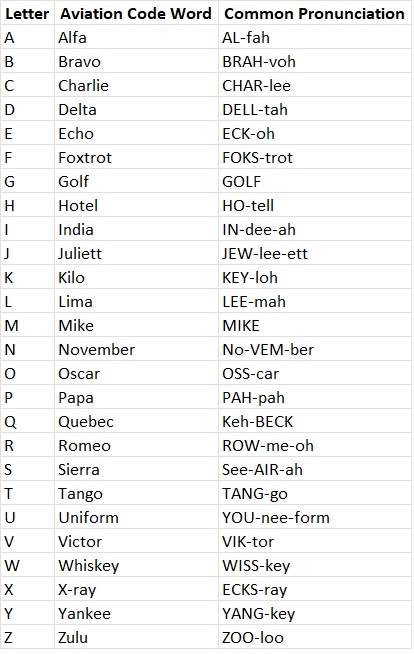
One detail worth remembering is that the official spelling includes Alfa and Juliett, rather than the more common English spellings “Alpha” and “Juliet.”
Why Is It Called the ICAO Phonetic Alphabet?
The standard aviation alphabet is closely associated with the International Civil Aviation Organization (ICAO), which established international standards to support safer and more consistent aviation operations.
Before a universal system was widely adopted, different countries and organizations used different words for letters. This could create confusion when people from different regions communicated with one another.
A standardized system made international communication more consistent.
Today, a pilot communicating from one part of the world can use the same basic phonetic alphabet as an air traffic controller or aviation professional in another country. The shared terminology helps reduce ambiguity and supports efficient communication across international aviation operations.
The ICAO system is also recognized beyond aviation and is commonly used in military, maritime, emergency response, and other industries where verbal accuracy is important.
Aviation Numbers: How Pilots Pronounce Numerals
The aviation communication system also includes standardized pronunciations for numbers.
Certain numbers can sound similar to one another or may be misunderstood by people with different accents. To improve clarity, aviation uses specific pronunciations.
Some common examples include:
- 3 – Tree
- 4 – Fower
- 5 – Fife
- 9 – Niner
For example, an aircraft or flight number may be spoken using the standardized pronunciation to make the message clearer over the radio.
Instead of relying on everyday pronunciation, pilots and controllers follow established communication standards designed to minimize confusion.
These small differences may seem unusual at first, but they serve an important purpose: helping ensure that critical information is understood correctly.
Where Is the Aviation Alphabet Used?
The aviation phonetic alphabet is used in many different aviation situations.
Aircraft Call Signs
Pilots may use phonetic code words when spelling or confirming an aircraft’s registration or call sign.
Air Traffic Control Communication
Controllers and pilots use standardized terminology to communicate instructions, identifiers, and other important information.
Airport and Navigation Identifiers
The phonetic alphabet can help clarify letters associated with airports, waypoints, and other navigation references.
Aviation Maintenance
Maintenance professionals may also use phonetic terminology when discussing aircraft components, records, part information, or technical details.
Flight Training
Student pilots typically begin learning the aviation alphabet early in their training because it is a foundational part of aviation radio communication.
Whether you’re training for your first flight or working with advanced aircraft systems, understanding standardized communication terminology is an important part of aviation knowledge.

Are There Variations of the Aviation Alphabet?
The ICAO phonetic alphabet is the recognized international standard, but local practices and operational circumstances can occasionally affect how certain words are used.
For example, organizations may avoid using a particular code word if it could be confused with an airline name, local terminology, or another frequently used identifier.
However, pilots and aviation professionals should understand the official standardized alphabet and follow applicable communication procedures.
Consistency is one of the main benefits of the system. When everyone uses recognized terminology, it becomes easier to communicate clearly regardless of location or native language.
How to Learn the Aviation Alphabet Quickly
Learning the complete aviation alphabet does not have to be difficult. You can begin memorizing the system in just a few minutes by breaking it into smaller groups.
1. Learn a Few Letters at a Time
Start with three to five letters rather than trying to memorize the entire alphabet immediately.
For example:
Alfa, Bravo, Charlie, Delta, Echo
Repeat them aloud several times before moving to the next group.
2. Spell Your Name
Once you know a few code words, practice using them to spell your name.
For example:
J – U – L – I – E
would become:
Juliett, Uniform, Lima, India, Echo.
This is an easy way to turn memorization into practical use.
3. Practice Out Loud
The aviation alphabet is primarily used for verbal communication, so saying the words aloud can help you become more comfortable with them.
Try reading the alphabet from A to Z, then practice in reverse or choose random letters.
4. Use Flashcards
Flashcards can help you quickly test yourself. Place the letter on one side and the corresponding aviation code word on the other.
Short, frequent practice sessions can be more effective than trying to memorize everything at once.
5. Practice Real Aviation Examples
Try spelling aircraft registrations, airport codes, names, or call signs using the phonetic alphabet.
The more often you use the words, the more natural they become.
Why the Aviation Alphabet Works
The aviation alphabet was created with one major goal: reducing ambiguity.
A single spoken letter may be difficult to understand, particularly when communication takes place over a noisy radio channel. Accents, interference, fatigue, stress, and distance can all affect how a message is heard.
Distinct code words provide additional context.
For example, there is much less room for confusion between:
Mike
and
November
than there may be between the letters M and N when spoken quickly over a weak radio signal.
Each word is designed to be recognizable and distinguishable from the others. This makes the system especially valuable in environments where communication accuracy is critical.
The Aviation Alphabet Beyond the Cockpit
Although most people associate the phonetic alphabet with pilots and air traffic controllers, its usefulness extends beyond the flight deck.
The system is also commonly used by:
- Aviation maintenance teams
- Emergency services
- Military organizations
- Maritime crews
- Law enforcement agencies
- Radio operators
- Customer service and technical support teams
Any situation involving difficult verbal communication can benefit from a clear way to identify letters.
However, in aviation, the importance of communication is especially significant. Accurate information helps support safer, more efficient operations from preflight planning through landing.
Why Every Pilot Should Know the Aviation Alphabet
For pilots, learning the aviation alphabet is a fundamental part of developing effective communication skills.
Student pilots encounter the system early because radio communication is an important part of flight operations. As pilots gain experience, the phonetic alphabet becomes second nature.
Knowing when and how to use standardized terminology can help pilots:
- Communicate aircraft information clearly
- Confirm call signs and identifiers
- Reduce misunderstandings
- Improve radio communication skills
- Follow accepted aviation communication practices
- Communicate more confidently in international environments
The system may be simple, but its role in aviation communication is significant.
From Alfa to Zulu, each code word represents a shared language that helps aviation professionals communicate with greater clarity.
Frequently Asked Questions About the Aviation Alphabet
How can I learn the aviation alphabet quickly?
Start by dividing the alphabet into small groups and repeating each group aloud. Practice spelling your name, common aviation terms, or aircraft registrations using the code words. Regular practice will help you recall the words more naturally.
What is the official aviation phonetic alphabet?
The official international system commonly used in aviation is the ICAO phonetic alphabet, which assigns a unique code word to every letter from A through Z, including Alfa, Bravo, Charlie, Delta, and Zulu.
Why do pilots say “Niner” instead of “Nine”?
In aviation communication, standardized pronunciations help reduce the possibility of misunderstanding. “Niner” is used to make the number easier to distinguish during radio communication.
Is the aviation alphabet used around the world?
Yes. The ICAO phonetic alphabet is an internationally recognized standard and is widely used in aviation communication around the world.
What is the easiest way to memorize the phonetic alphabet aviation system?
Practice using it instead of simply reading it. Spell your name, create flashcards, test yourself with random letters, and say the code words aloud. Repetition and practical use can make memorization easier.
Final Thoughts: From Alfa to Zulu
The aviation alphabet is one of the simplest yet most useful communication systems in aviation. By replacing individual letters with distinct code words, it helps reduce confusion and supports clearer communication when every detail matters.
For new pilots and aviation enthusiasts, learning the aviation phonetic alphabet is an excellent introduction to the language used throughout the aviation industry. With just a few minutes of practice, you can begin recognizing and using the complete aviation alphabet code from Alfa to Zulu.
At Palm Beach Avionics, we understand that safe aviation depends on precision, reliability, and clear communication. Our FAA-approved and NCATT-certified team provides professional avionics services, including aircraft avionics repair, installations, upgrades, and support to help aircraft owners and operators maintain reliable, modern aviation systems.
Whether you are flying locally in South Florida or operating beyond the region, dependable avionics technology and knowledgeable support can help keep your aircraft prepared for every flight.
40+ Years Serving South Florida in Avionics and Aircraft Maintenance
Palm Beach Avionics has been dedicated to providing top-notch avionics and aircraft maintenance services in South Florida for over four decades. Our team of highly skilled professionals takes pride in delivering exceptional quality workmanship, ensuring the safety and reliability of every aircraft we service.

Fact Checked For Accuracy
Our team has fact-checked this article for accuracy. Read about the editorial standards we employ on our website to ensure your safety and wellbeing.

About The Author
Rei Bayucca is a private jet enthusiast and professional writer. With many years of experience, she crafts articles that educate and inform her readers.