
Aircraft Composites: Types, Benefits & Future Trends
Published September 17, 2026
Aircraft are built to be strong, safe, and light. But how can they handle heavy loads and long flights without becoming too heavy? The answer is often found in aircraft composites. These strong, light materials are now a key part of modern aircraft design.
They help planes use less fuel, carry more, and fly with better efficiency. But what are aircraft composite materials, and why are they so useful? In this guide, we will explain the main types, key benefits, and new trends in composite materials in aircraft.
Let’s see how these materials are changing the future of aviation.
What Are Aircraft Composites?
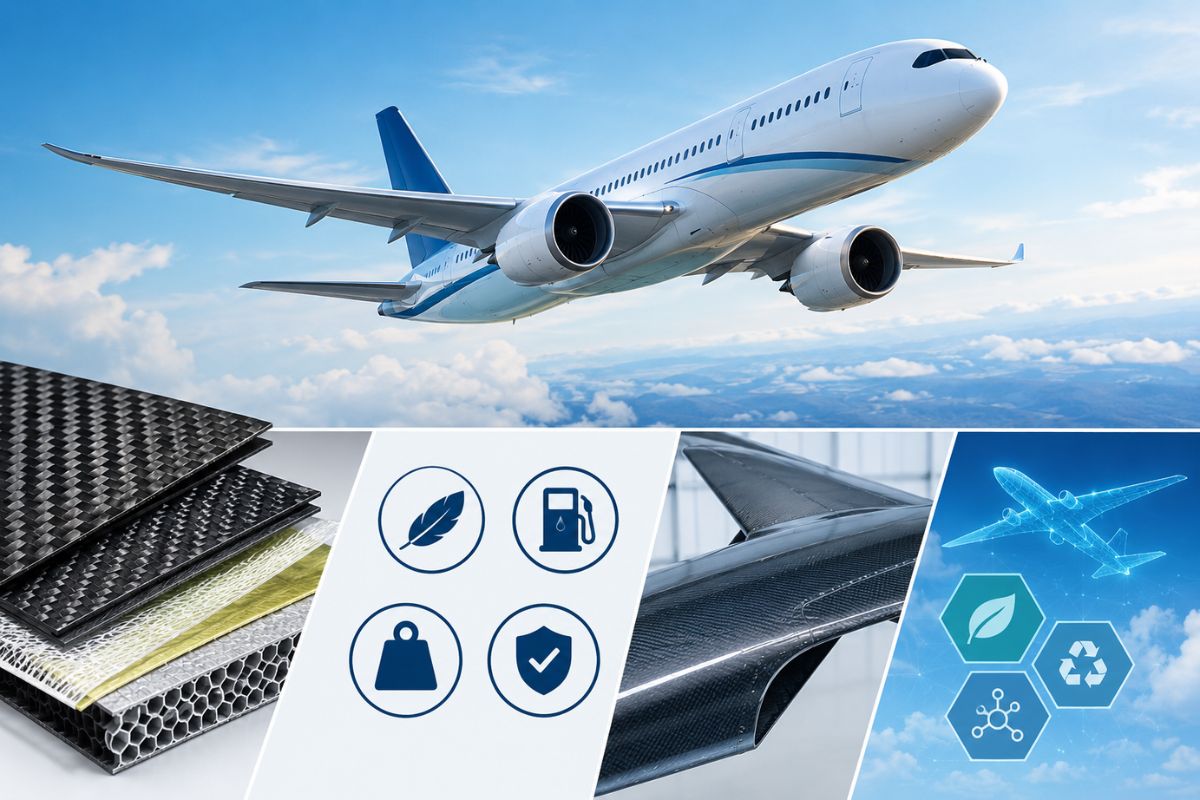
Aircraft composites are made by joining two or more materials to create one strong material. In most cases, they use strong fibers and a resin that holds the fibers together. The fibers add strength, while the resin helps keep the shape in place.
Common fibers include carbon fiber, glass fiber, and aramid fiber. These materials can be shaped into many parts of an aircraft. Unlike some metals, composites do not rust or corrode in the same way.
This makes aircraft composite materials useful for many parts, from large body sections to smaller panels and interior parts.
Why Do Planes Need Composite Materials?
A plane must be strong enough to carry people, fuel, and cargo. At the same time, it should not be too heavy. So, what happens when engineers can cut weight without giving up strength? This is where composite materials in aircraft can help.
Many composites have a strong strength-to-weight ratio. This means they can provide high strength while adding less weight than some older materials. A lighter aircraft can need less fuel during flight. It may also carry more useful weight.
For airlines, these benefits can support better fuel use, lower costs, and more efficient flights.
Carbon Fiber Leads the Way
Carbon fiber is one of the best-known materials used in modern aircraft. It is made from very thin carbon strands that are joined with resin. The result is a material that is strong, light, and stiff. These features make carbon fiber useful for major aircraft parts.
Engineers can also shape it to fit complex designs. This gives them more freedom when building wings, body sections, and other parts. Carbon fiber can cost more to make than some metals, but its low weight can bring major benefits.
As aircraft design moves forward, carbon fiber remains an important part of aircraft composites.
Fiberglass Has a Role Too
Not every aircraft part needs the same type of material. Fiberglass is another common choice in aviation. It is made from very fine glass fibers placed inside a resin. Fiberglass is lighter than many metals and can be made into different shapes.
It is also useful when cost and strength both matter. You may find fiberglass in panels, covers, fairings, and other aircraft parts. It may not have the same strength as carbon fiber, but that does not make it less useful. Engineers choose materials based on what each part needs.
This helps make aircraft composite materials practical for many uses.

Strong Fibers Help Protect Aircraft
Some aircraft parts need to handle bumps, hits, or other stress. This is where aramid fibers can help. Kevlar is one well-known type of aramid fiber. It is light and has good strength and impact resistance. These features can make it useful for areas that need extra protection.
The fiber is placed inside a resin, much like other composite materials. Together, they form a strong structure that can meet the needs of an aircraft. Different fibers have different jobs, so engineers do not use one material for everything.
Instead, they choose the right mix for each part and purpose.
Where Are Composites Used?
Aircraft composites can be found in many areas of a modern plane. Large structures, such as wings and fuselage sections, may use composite materials. Smaller parts can also use them, including fairings, panels, doors, and interior pieces. Why use composites in so many places?
Their low weight, strength, and design flexibility make them useful for different needs. Engineers can build parts in shapes that may be harder to make with metal. This can help improve the way air moves around an aircraft.
As technology improves, more aircraft parts can be made with carefully designed composite materials in aircraft.
Less Weight Can Mean Less Fuel
One of the biggest reasons to use aircraft composite materials is simple: weight matters. An aircraft must use energy to stay in the air and move forward. A lighter plane may need less fuel to complete a flight. Over many flights, even small weight savings can matter.
Composites can help engineers build strong parts without adding as much weight as some traditional materials. This can support better fuel efficiency and lower operating costs. It can also help an aircraft carry more passengers or cargo.
In aviation, saving weight is not just about making a plane lighter, it can affect its whole operation.
Composites Can Last a Long Time
Aircraft face many hours of flight, changes in temperature, vibration, and repeated stress. The materials used to build them must handle these conditions. Many aircraft composites offer good resistance to fatigue and corrosion.
Metals can develop corrosion when exposed to certain conditions, while composites do not rust like metal. This can help reduce some maintenance needs. However, composites still need careful checks and proper repairs.
Damage may not always look serious from the outside. Aviation teams use special methods to inspect composite parts and find hidden problems. Good design, inspection, and care all play a part in keeping composite aircraft safe.
New Technology Is Changing Composites
The future of aircraft composite materials is not only about making stronger parts. Engineers are also working to make composites easier, faster, and more affordable to produce. New tools can help improve how fibers and resin are placed and shaped.
Better production methods may also reduce waste and save time. Another key area is recycling. Composite parts can be harder to recycle than many metals, so researchers are looking for better ways to reuse their materials.
These changes could help solve some of the current limits of composites. As new ideas grow, composite technology may become even more useful across aviation.
What Does the Future Hold?
The use of composite materials in aircraft is likely to remain an important part of aviation design. Modern planes already use composites for many key parts, and new aircraft continue to explore their benefits. But the goal is not simply to use more composite material.
Engineers must find the right balance between strength, weight, cost, safety, production, and repair. Future designs may use smarter materials and better manufacturing methods to meet these needs.
From lighter aircraft to more efficient flights, composites can help shape what comes next. The big question is no longer if composites belong in aviation, but how far they can go.
FAQs
What are the different types of aircraft composites?
The main types include carbon fiber, fiberglass, and aramid fiber composites. These materials are combined with a resin to create strong and lightweight parts.
What are the future trends in plane flying?
Future trends include more fuel-efficient aircraft, electric and hybrid flight, improved aircraft designs, and greater use of aircraft composite materials.
What are the future prospects of composite materials in the aerospace industry?
Composite materials in aircraft are expected to see wider use as engineers develop lighter, stronger, more affordable, and easier-to-recycle materials.
What are the 7 categories of aircraft?
The seven common aircraft categories are airplanes, rotorcraft, gliders, lighter-than-air aircraft, powered-lift aircraft, powered parachutes, and weight-shift-control aircraft.
What are the four types of aircraft?
Four broad types are airplanes, helicopters, gliders, and lighter-than-air aircraft, such as balloons and airships.
Final Thoughts
Aircraft composites have changed how modern planes are built and maintained. Their strong yet light design can help improve fuel use, flight performance, and aircraft life. Materials such as carbon fiber, fiberglass, and aramid fiber each serve different needs.
As new technology grows, engineers are finding better ways to make, inspect, repair, and reuse these materials. For aircraft owners, proper care is still important. At Palm Beach Avionics, our FAA-approved team provides aircraft maintenance, repair, and avionics services backed by decades of aviation experience.
40+ Years Serving South Florida in Avionics and Aircraft Maintenance
Palm Beach Avionics has been dedicated to providing top-notch avionics and aircraft maintenance services in South Florida for over four decades. Our team of highly skilled professionals takes pride in delivering exceptional quality workmanship, ensuring the safety and reliability of every aircraft we service.

Fact Checked For Accuracy
Our team has fact-checked this article for accuracy. Read about the editorial standards we employ on our website to ensure your safety and wellbeing.

About The Author
Rei Bayucca is a private jet enthusiast and professional writer. With many years of experience, she crafts articles that educate and inform her readers.